
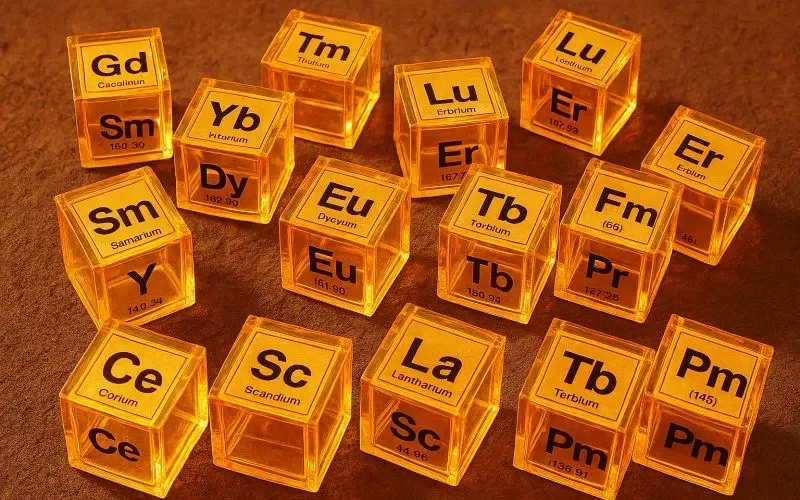
Working on my preparations for the Lanthanide webinar on the 24th, it struck me again that Lanthanides seem to have a special status among homeopathic remedies. Not so much because they were discovered relatively recently (the last one only in 1945) and therefore were called ‘hidden’ but mainly because they have the reputation of being remedies for spiritual people. They share that status with Gemstones, be it for different reasons.
It is not hard to see to why, as the essence of Lanthanides can be expressed in just one word ‘Self’. (How much more manageable homeopathy would be if we could boil down the essence of each Remedy group or Family to one word! I’m working on it).
Let me explain it further.
On the Vital Approach Map of Homeopathic Families there is a 2D page and a 3D page.
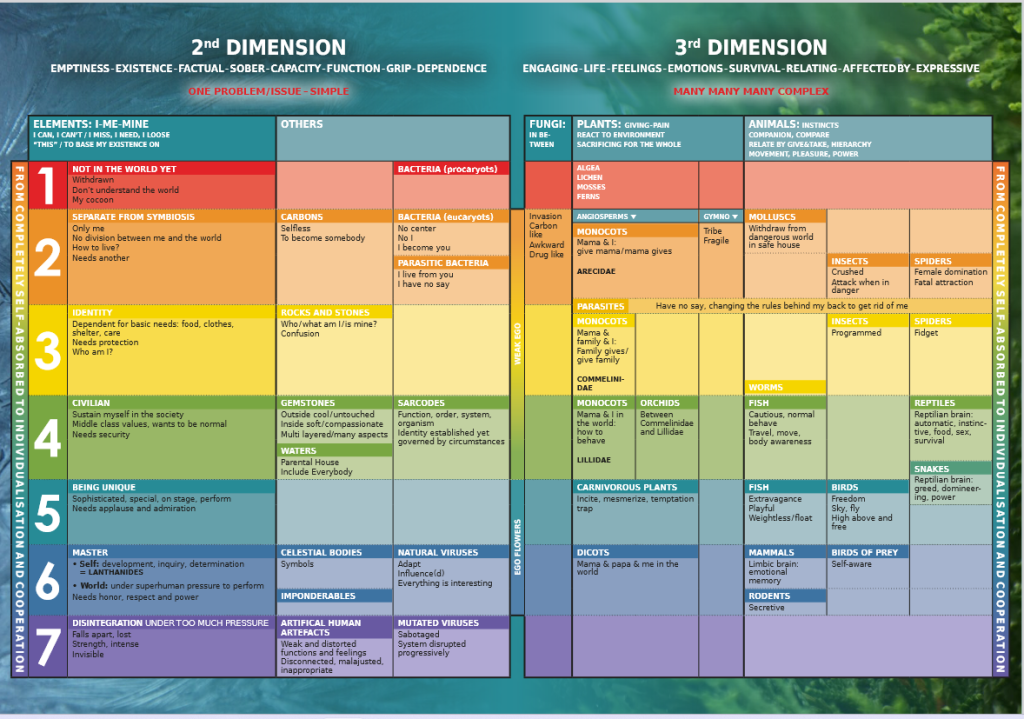
All groups of 2D (second dimension) have similar characteristics. The group of Elements on the far left are the building blocks and the blueprint for all other homeopathic Groups and Families. The keynotes are written on top of the page and apply to all Groups on that page. Hence: the first word is ‘emptiness’, which is the vital sensation. When we realise that atoms, and by extension all matter, is merely empty space, it becomes logical and comprehensible. Unfortunately, many patients won’t be able to verbalise that existential experience. It shouldn’t be a problem, as we can do with the expressions thereof on the other levels (mind and body).
The basic issue is: my capacity (can I? or I can’t). What 2D need is stability, grip as a foundation for its existence. The feelings are heavy, with a desire to become lighter. In consultation the patient makes a rather aloof, distant, sometimes monotonous impression and talks about abstract concepts (like meaning, role, function, structure) labelling his experiences rather than sharing them.
A 3D patient gives the whole picture of en event, sharing every detail and emotion.
Let me give an example: a 3D patient could tell you: “…. after he left me, I fell apart, like my whole world crumbled around me, I felt completely lost and was on the couch for days, crying, sobbing, feeling like my life ended, I don’t know where the tears kept coming from and it took me days before I even got up and got dressed to buy some groceries and in the shop the lady looked at me and asked if I was OK but what could I say, and I came home, honestly, with crisps and a bottle of wine to drown my grief and hurt”. (this is the short version).
A 2D patient might say: “After he left me, I felt abandoned”.
I-Me-Mine
Another striking feature of 2D Groups and Families is that the patients seem to be the only character in their life theatre. When there are other characters, they are only mentioned in relation to his own problem. It goes without saying that in daily life 2D people are as normal as everybody else (…) with families, jobs, friends, hobbies and the like. The difference is that 3D people feel themselves part of a dynamic living environment, say: of the web of life, by which they are influenced and to which they react.
2D people usually don’t talk much about their environment, if at all, and are not (much) affected by it. This is the reason why we get no or very few modalities for their complaints, and only after asking. The general rule in case taking is: everything that didn’t come spontaneous is not trustworthy. If you had to ask for it, it might as well have been a polite answer to your question and not of any importance. For this reason, we don’t ask about their family, spouse, job, friends, childhood, if the patient didn’t mention these topics himself. Because if he didn’t, it means it’s not the focus of their problem.
With 2D patient we often we find ourselves running out of inspiration, as the patient usually doesn’t share elaborate stories but instead waits for your next question. They see you in your role (abstract concept) as the expert and assume you know what information is important. For this reason, the consultation with 2D patients can be more formal, dry, sober, talking about one topic, having the character of an interview with questions and answers.
In the end the homeopath still doesn’t know much about the family or social situation of the patient. That is why you find I -Me-Mine on the Map. It is all about ‘Me’ in 2D, and most outspoken in Elements.
All Self oriented?
One could argue that all Elements are self-oriented and therefor ‘Self’ applies to all of them. This is true but according to the Row they also have other issues to tackle.
Row 1 is ‘not in the world yet, this means the Self has no mirror yet, no tool to know itself. Row 2 must first and foremost deal with becoming a separate being and stay alive.
Row 3’s main question is ‘who am I?’, building up its identity.
Row 4 must mobilise all his capacity to be a member of society.
Row 5’s ‘condition to be OK’ is to receive applause and admiration for his unique talents.
It is finally Row 6 who is beyond all these challenges and is focused on gaining Mastery.
Difference between Lanthanides and other Row 6 remedies.
What makes the Lanthanides different than the other elements on Row 6, also called the Aurum row, is their attempt for mastery concerns themselves, not the outside world. Lanthanides all belong to Row 6 but open up, if you wish, at Column 3 as a new fractal. Column 3 is the ‘doubt what’ column (for more information, see the Family Finder) and as all Lanthanides have this is common (perhaps reason why it was so difficult to isolate them), it will be noticed in consultation as a background sound, regardless of the specific column the Lanthanide is located. Maybe one of the reasons why they were so difficult to separate? Originally scientists thought it was all just one new element?
Row 6 people are destined to strife for power, honour and respect. The question ‘how’ ? is answered with ‘let’s start by myself’ in Lanthanides, hence the Self is on the foreground, as a matter of fact is the one and only issue.
The autonomous Self
As the Self is what needs to be mastered, it becomes: self-inquiry, self-awareness, self- reflection, self-control, self-improvement, self-empowerment….
A mastered self is autonomous, can’t be bought or sold, used or abused, coerced or manipulated. Even if the patient doesn’t use the word ‘Self’ or ‘autonomy’, it is up to the homeopath to understand what is at stake. When the vital disturbance (or sensation) is not expressed directly, it will be indirectly in examples, areas of difficulties, or triggers who point to sensitivities. The vital disturbance is on all levels all the time, so it can’t be hidden from the homeopath who knows what he is looking for.
The consultation with a Lanthanide
During the consultation the Lanthanide patient is aware of all the homeopaths questions and his answers, witnessing the whole process from an inner and outer point of view at the same time. It is as if there is a 3rd person in the room. The patient is so used to be aware and witness his own behaviour and reactions, he might not even know he is doing this. As this applies to all of us: we find our own state the only normal unquestioned way of being and usually we are not aware others operate from their normal , but different state. Unless you are homeopath, of course.
It’s possible the Lanthanide will surprise you by saying: ‘you’ve asked this question some time ago in other words and my answer was… ‘ or: ‘I don’t know if this is the way a homeopathic consultation is supposed to enfold’ or any other remark that tells you the patient is aware of you, himself and the process at the same time.
The differentiation with Animal remedies who are ‘keeping an eye on you’ and are as all 3D Groups and Families aware of their surroundings, is that there is no threat, no danger, no gauging who is superior or inferior. Even when the Lanthanide makes a remark on the homeopathic question, it will be factual and objective, not as in Animal Kingdom to give an evaluation on the homeopath’s performance/intelligence/ appearance etc.
Where does spirituality come in?
After explaining why self-awareness and self-improvement comes naturally in Lanthanides as it is their ‘condition to be OK’, it is easy to see the overlap. Often the patient will call himself a spiritual seeker but here is the pitfall: many of our patients say so.
When in the 60s, prevailing religions no longer provided answers for people’s yearning for meaning and transcendence, trends from Eastern spirituality were embraced. Starting in the 70s Indian gurus flooded the West and with them came yoga, meditation, mantras, ashrams, retreats, the whole lot. Coinciding with another trend from the East, macrobiotics, that got foot on the ground and introducing the concept of yin and yang. Add to this the resurgence of ‘alternative’ treatments, with their holistic approach. This also turned out for many more attractive, compared to the ‘Flatland’ materialistic approach of regular medicine. When science has nothing to offer but chaos, randomness and meaninglessness, it is no wonder alternative medicine, spiritual teachings or any philosophy promising a healthy mind in a healthy body, were the preferred way for many. It is here that spiritual seekers find each other.
Homeopathy and spirituality
We have more than average number of spiritual inclined people in our practices, for the reasons just mentioned above. Are we going to give them all Lanthanides? Obviously not.
A spiritual person can be any remedy of the Materia Medica, though some groups are more likely than others. As I wrote in previous blogs and can’t emphasize enough: we first must differentiate whether we deal with level 4 (psyche) or level 5 (state) information.
The self-awareness and self-improvement might make a Lanthanide interested in spirituality, sure, but on the other hand they don’t particularly like spiritual gatherings or rituals as they protect their autonomy at all costs. They rather philosophy than take action, it is more an intellectual endeavour than a compassionate tendency. Learning in order to control and earn respect is their first motivation.
Lanthanides as homeopaths
It is said that homeopathy is one of the professions a Lanthanide feel drawn to. This being the case, it must be said that this applies to all Row 6 people. They take natural responsibility for others, even, and especially in matters of life and death. When their capacities are not developed due to cultural and social reasons (hence, not becoming a surgeon or a CEO) they can challenge their own power at the edge of life and death, for instance with dangerous sports. They will risk their life again and again, to prove their mastery and earn respect, even if it only self-respect.
But Lanthanides with their Element quality of ‘I-Me-Mine’, their Row 6 drive for mastery and respect and their focus on Self, it becomes clear that this combination provides for a good foundation. As all 2D people have enough distance to others (who are ‘not-me’) they won’t be overly burdened by their patient’s suffering. Too empathic homeopaths are more in danger to be emotionally drained and burnout.
Conclusion
Spiritual people, seekers, therapists, philosophers can be found in all Groups and Families. It is the underlying motivation that counts. When it is to end suffering, think Plant, when it is to take action and do something for the deprived members of society, think Gemstones, when it is out of fear of death, think Animal, when it is out of curiosity, think Virus.
When the basic line is to gain or maintain autonomy, think Lanthanide.


